Nepal’s Devastating Flood Flowed at 188 kmph, Scientists Claim


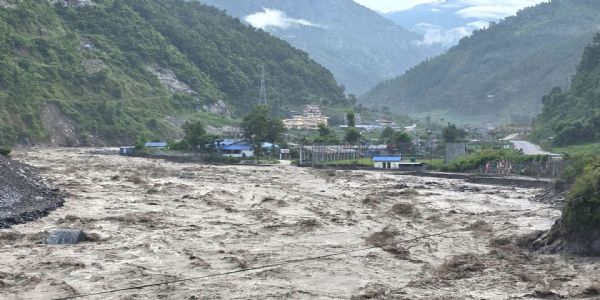
Kathmandu, 19 September (H.S.): Scientists studying and researching the devastating flood that swept into the Bhotekoshi River in Rasuwa, Nepal, after originating in Tibet, continue to uncover new findings about the disaster. In the latest development, World Weather Attribution (WWA), an international organisation that studies extreme weather events, has released new findings regarding the speed of the Bhotekoshi flood.
Earlier, Nepalese flood experts had described the Bhotekoshi flood as the fastest flood recorded in the country so far. On August 27, a day after the disaster, flood expert Dinkar Kayastha had estimated that the flood may have travelled at speeds of up to 55 kilometres per hour. He had said it could possibly be the fastest flood ever recorded in Nepal.
However, the WWA study has estimated that the flood travelled at more than twice that speed. According to the WWA, on August 26, a massive section of rock located at an altitude of more than 5,150 metres in the Langtang Lirung Himal in Rasuwa broke away and collapsed. A portion of the glacier situated above it also came down with the rock mass. The enormous quantity of rock and ice cascading downhill triggered a rapidly moving mixture of water, mud, boulders and ice.
According to the report, by the time the debris reached Lhende Khola, it had transformed into a powerful flood. The flood travelled at an average speed of approximately 188 kilometres per hour.
More than 20 scientists from different countries contributed to the study. The report was prepared with the collaboration of researchers and experts including Ben Clarke, Miriam Zachariah, Bethan Davies, Rejine Hacquard and Walter Immerzeel.
22 km covered in just seven minutes
According to the report, the flood travelled approximately 22 kilometres from the Langtang region to the Rasuwagadhi border area in just seven minutes. The speed has been described as comparable to that of a conventional passenger train. Scientists said that such a flow had not previously been observed in Nepal’s rivers.
At this speed, the mixture of rock, ice, mud and water surged into the Bhotekoshi River before causing extensive destruction downstream.
Five districts suffer extensive devastation
The flow, carrying ice, rocks and massive quantities of debris, travelled through the Bhotekoshi and eventually reached the Trishuli River. In the process, 15 local administrative units across five districts, including Rasuwa, Nuwakot and Dhading, suffered extensive loss of life, property and infrastructure.
More than 1,400 deaths have so far been confirmed in the disaster, while around 6,000 people are reported missing. Infrastructure worth billions of rupees has also been destroyed by the flooding.
The powerful flow caused extensive erosion and destruction in several areas, including Timure, Syafrubesi, Mailung, Betravati, Sole, Tupche, Bhainse, Trishuli Dhunge and Devighat.
Flood reached Devghat, 200 km away, in less than seven hours
According to the scientists’ study, the floodwaters reached Devghat in Chitwan, approximately 200 kilometres away, in less than seven hours. At Devghat, the river discharge rose to around 5,850 cubic metres per second.
Scientists estimated that an additional volume of approximately 20 million cubic metres of water entered the river in less than four hours. In addition, around 30.5 million cubic metres of mud, rocks and other debris were carried downstream and deposited across various areas.
The enormous volume of water and debris significantly intensified the scale of destruction in areas surrounding the Bhotekoshi and Trishuli rivers.
---------------
Hindusthan Samachar / Jun Sarkar